
Collection: DDR5 - Desktop RAM

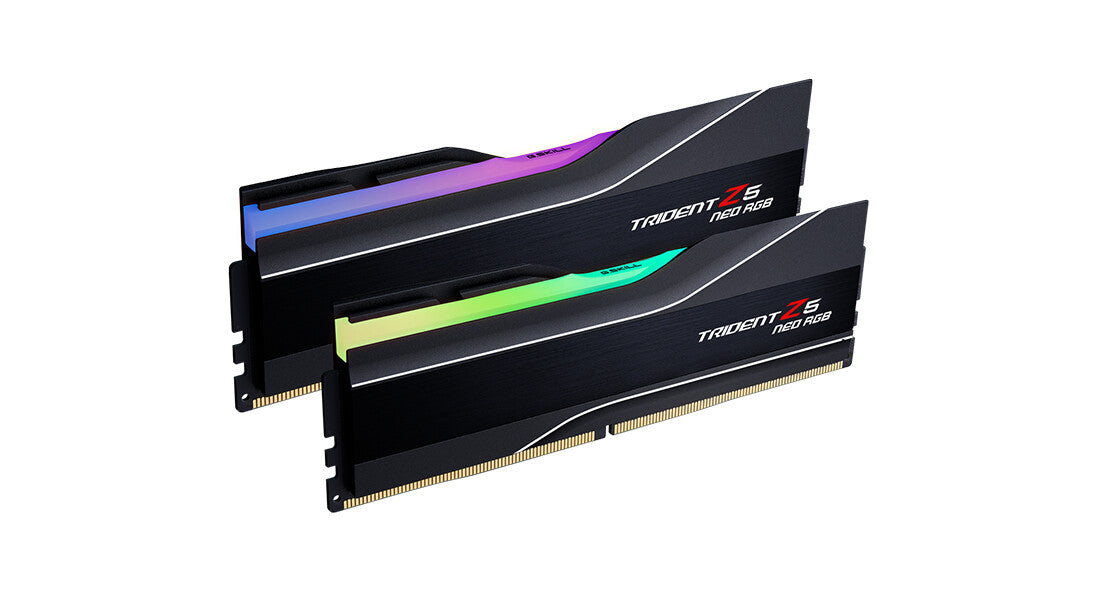
DDR5 - Desktop RAM
DDR5 – Desktop RAM is a fifth-generation double data rate synchronous dynamic random-access memory (DDR5 SDRAM) module designed for desktop computer motherboards. DDR5 – Desktop RAM stores short-term data that the CPU accesses during active workloads such as gaming, content creation, and multitasking. DDR5 – Desktop RAM increases bandwidth and memory density compared to DDR4 by using higher transfer rates and improved power management architecture. DDR5 – Desktop RAM requires a compatible DDR5 motherboard and cannot operate in DDR4 DIMM slots due to different pin layouts and electrical standards.
Buying Guide & Decision Logic
DDR5 – Desktop RAM selection should be based on capacity, frequency, latency, and motherboard compatibility. A 16GB kit (2×8GB) is generally sufficient for office tasks and entry-level gaming, while 32GB (2×16GB) is more suitable for modern gaming and content creation. Workstation users running virtual machines or large media projects may require 64GB or more.
DDR5 memory frequency typically ranges from 4800MT/s to 7200MT/s and higher. Higher MT/s improves memory bandwidth, which benefits CPU-intensive tasks and integrated graphics performance. CAS latency (CL) determines memory response delay; lower CL values reduce latency but often increase cost. A 6000MT/s CL30 kit may provide a balanced configuration for many AMD AM5 systems, while Intel platforms may scale effectively with higher frequencies. Users must enable XMP or EXPO profiles in BIOS to reach advertised speeds. Higher-speed kits can require stable motherboard VRM design and updated BIOS firmware.
Technical Specifications
DDR5 – Desktop RAM is defined by electrical, architectural, and performance characteristics that determine compatibility and throughput.
-
Memory type: DDR5 SDRAM
-
Form factor: 288-pin DIMM (desktop only)
-
Capacity per module: 8GB, 16GB, 24GB, 32GB, 48GB
-
Kit configuration: Single, dual-channel (2×DIMM), quad-channel (platform dependent)
-
Data rate: 4800MT/s to 7200MT/s+
-
Bandwidth: Higher than DDR4 at equivalent capacity
-
CAS latency (CL): e.g., CL30, CL32, CL40
-
Voltage: 1.1V standard; higher with overclock profiles
-
On-die ECC: Built-in error correction at chip level (not full system ECC)
-
Power management IC (PMIC): Integrated on module
-
XMP / EXPO support: Predefined overclock profiles
-
Channel architecture: Dual 32-bit subchannels per DIMM
-
Compatibility: Requires DDR5-compatible chipset and CPU memory controller
FAQ
Is DDR5 compatible with DDR4 motherboards?
DDR5 – Desktop RAM is not compatible with DDR4 motherboards because DDR5 uses a different pin layout and voltage regulation design. A DDR5 DIMM cannot physically fit into a DDR4 slot. Users must confirm that both the motherboard and CPU memory controller explicitly support DDR5 memory before purchasing.
How much DDR5 RAM do I need for gaming?
Most modern games run effectively with 16GB of DDR5 RAM, but 32GB can improve performance stability in memory-intensive titles and multitasking scenarios. Higher capacity reduces background swapping to storage. Capacity generally has a larger impact than extreme frequency increases once minimum system requirements are met.
Does higher MHz DDR5 improve performance?
Higher DDR5 memory frequency increases bandwidth and can improve performance in CPU-limited workloads and integrated graphics usage. Performance gains vary by platform and application, often ranging from small single-digit percentages to moderate improvements in memory-sensitive tasks. Stability depends on motherboard quality and BIOS support.
What is the difference between XMP and EXPO?
XMP (Extreme Memory Profile) is an Intel-defined memory overclocking profile, while EXPO (Extended Profiles for Overclocking) is defined for AMD platforms. Both store preconfigured frequency, voltage, and timing settings in the RAM module. Users must enable these profiles manually in BIOS to achieve rated speeds.